Classical Greece
Essential temples to visit by yacht
Because of the seafaring nature of the Greek civilizations, the majority of important archaeological sites and accompanying museums – including in what is nowadays Turkey – is ideally located to explore via (cultural) sailing holidays.
A solitary anchorage in a bay overlooked by a temple is de rigeur and even if there are tourists, these will leave the site deserted in the end of the afternoon.
- Paros – Paroikia archaeological museum [in French]
- Naxos – Demeter temple, cave on Mt. Zas "Zeus"
- Folegandros – Just north of Karavostasi port is the "Golden cave" or Chryssospilia, impossible to anchor but in light conditions you can approach the stone steps with a dinghy.
- Miletus • Priene • Didyma • Ephesus – A plethora of temples, excavations and sanctuaries, such as the temple of Artemis in Ephesus
- Delos – Temple complexes galore
- Olympia: the Philippeion and other structures
- Knidos
- Epidauros – Sanctuary of Asclepius and theatre

Greek temple architecture
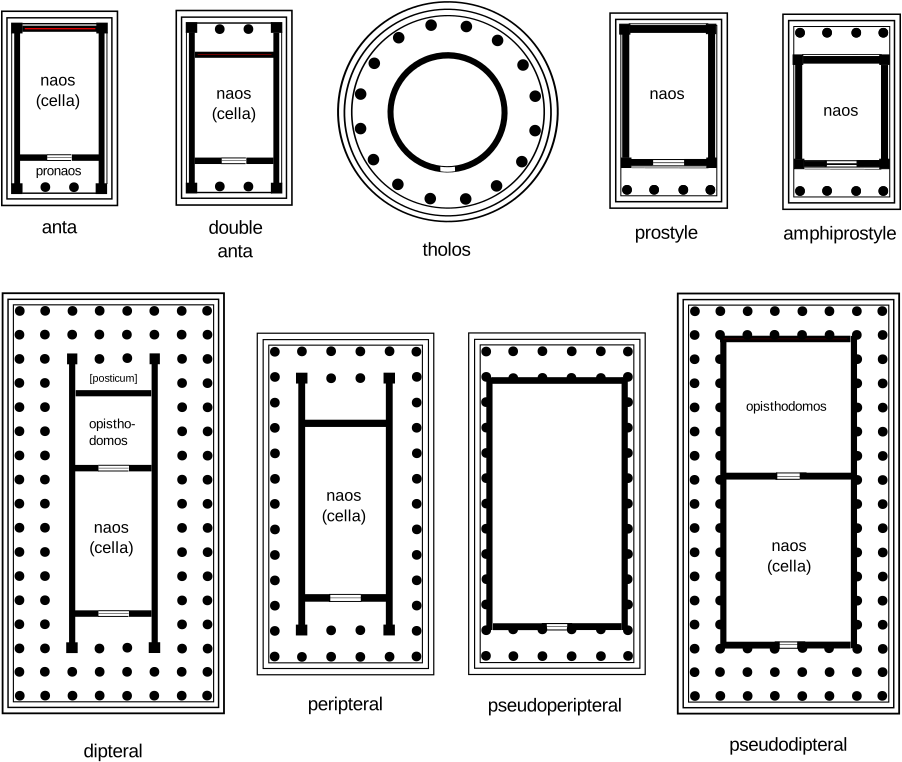
- The simplest form of greek temple is the temple in antis or in anta, in which the “naos” or “cella” is preceded by a “pronaos” or “antechamber” flanked by forward projections “antea” of its side walls. There are also examples of a double anta temple, with antea at each side.
- Where there is row of columns in front of the antea (one column in front of each of the antea, with two or four columns in between) the temple is known as prostyle.
Nostalgia
From New Latin nostalgia, coined from Ancient Greek νόστος (nóstos, “returning home”), a Homeric word, and ἄλγος (álgos, “pain”), read on…
- If there is a similar row of columns on the rear end of the temple it is known as amphiprostyle.
- From the second half of the 7th century BCE the classical form was the peripteral temple, in which the cella was surrounded on all four sides by a “peristasis” or “colonnade”, like the Parthenon in Athens.
- The dipteral temple has a double row of columns on all four sites; e.g. the Heraion of Samos.
- A further type of temple is the tholos, on a circular ground-plan, for instance in Epidauros and Delphi.
Classical orders
- In the Doric order the shaft of the column, which tapers towards the top and has between 16 and 20 flutings, stands directly, without a base, on the stylobate above the three-stepped substructure Crepidoma. The capital consists of the Echinus and the square Abacus and carries the Architrave with its frieze of triglyps and metopes
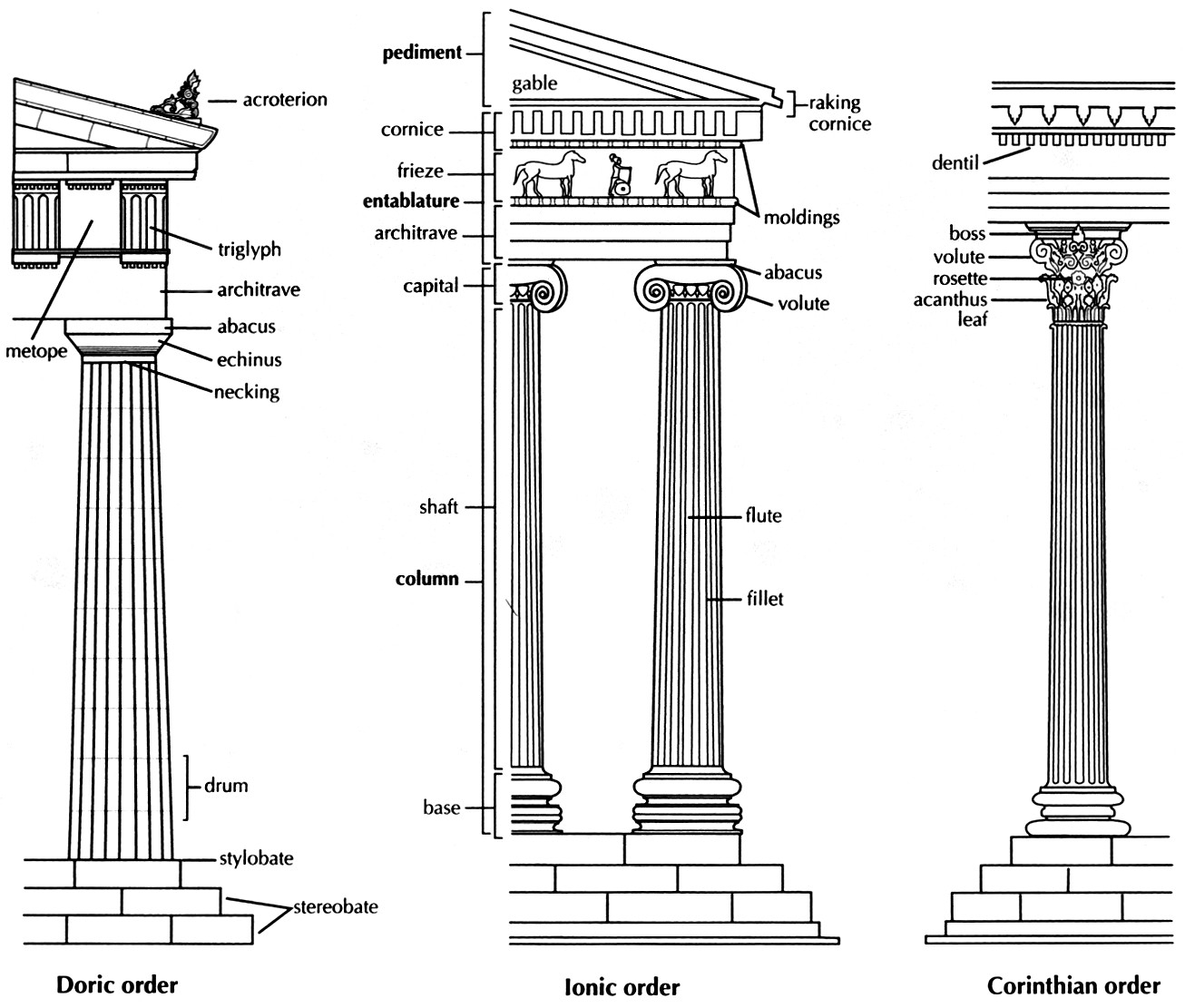
- The Ionic order has slenderer and gentler forms than the Doric, the “male” order. The flutings of the columns are separated by narrow ridges. The column stands on a base (for example the Attic type base). The capital has typical spiral volutes on either side. The architrave is made up of three flat sections, each projecting over the one below. The frieze is continuous, without triglyphs to divide it up. Also, note the difference between the terms Ionian and Ionic.
- The Corinthian order is similar to the Ionic except in the form of the capital. Its characteristic feature is the acanthus leaves which enclose the circular body of the capital, with tendrils reaching up to the corners of the concave architrave. This order was much favoured under the Roman Empire.
Further reading
The Tower of the winds on the Roman Agora
The Acropolis in Athens
Independent advise on sailing holidays in Greece and Turkey
Our latest logbook
The ancient Diolkos and Corinth Canal
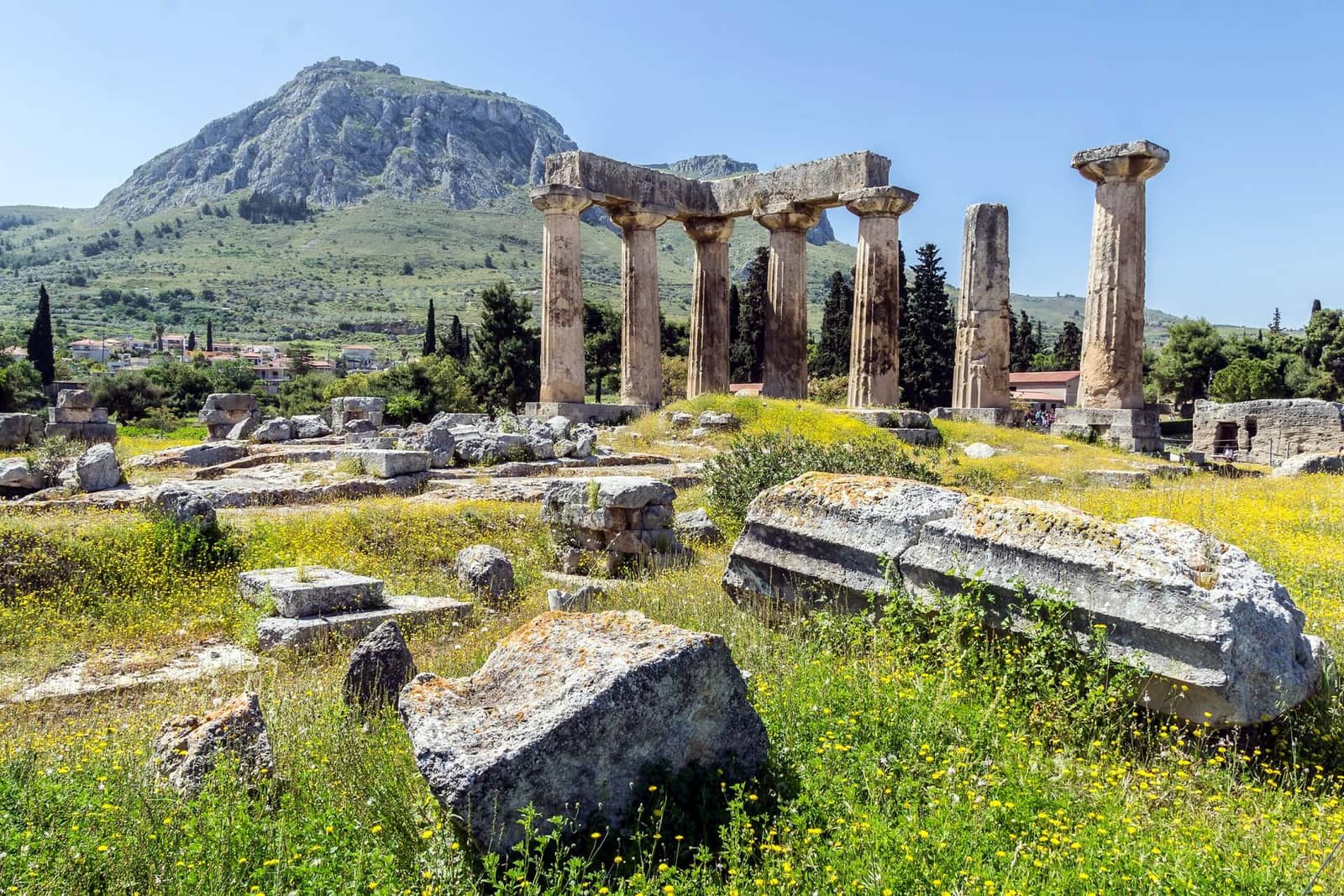
Built around 560 BCE, it is one of the earliest Doric temples in the Peloponese and Mainland Greece.