Tower of winds
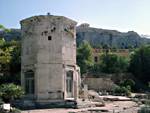
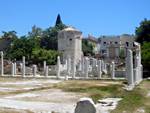
On the Roman Agora overlooked by the acropolis and the parthenon – see Classical Greece for yachtspersons – stands the octagonal marble edifice of the Horologion of Andronicos which was erected by the Macedonian astronomer Andronicos around 50 BCE.
Pentelic marble
Pentelic marble is quarried just North of Athens and has a mesmerizing white crystalline surface. It looks delicate as…read on…
This Tower of winds was build with pentelic marble and stands over 12 metres high, originally topped by a revolving bronze weather vane depicting Triton
A pointed wand in his hand indicated the direction from which the wind was blowing.
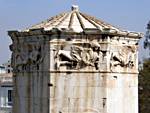
To the ancients, the winds had divine powers and on the frieze of each side below the conical rooftop there is a sculpted figure of one of the Anemoi or a wind deity ruling the compass point to which it faces.
The term Horologion also acknowledges the other features of the tower that Andronicos incorporated: sundials and a complicated internal water clock with a supply from the Acropolis above.
| Wind direction | Wind deity | Sculpted Character |
|---|---|---|
| North | Boreas | Man wearing a heavy cloak, blowing through a twisted shell |
| North East | Kaikias | Man carrying & emptying a shield of small round objects |
| East | Apeliotes | Young man holding a cloak full of fruit and grain |
| South East | Euros | Old man wrapped tightly in a cloak against the elements |
| South | Notos | Man emptying an urn and producing a shower of water |
| South West | Lips | Boy pushing the stern of a ship, promising a good sailing wind |
| West | Zephyros | Youth carrying flowers into the air |
| North West | Skiron | Bearded man with a bronze pot full of hot ashes and charcoal |
In the early Christian period, the Tower of the Winds was converted into a church. Later on, it became covered with the earth and debris that had accumulated over the centuries, but was excavated by the Greek Archaeological Society around 1837 – 1845. Modern restorations took place during WO I, as well as in 1976. Recent restoration work was completed in August 2016.
Read more articles in my yachting guide.
Yachting guide
- Charter guide
- Assisted bareboats
- Bareboat requirements
- Choosing a charter yacht
- Catamarans & monohulls
- Prevent seasickness
- Greek sailing areas
- When to sail in Greece
- Yacht charter provisioning
- Itineraries Ionian
- Itineraries Argo-Saronic
- Itineraries Cyclades
- Itineraries Dodecanese
- One-way itineraries
- Flights & ferries
- Last minutes & budget
- Sailing between Greece & Turkey
- Greek chart terms
- Greek fishing techniques
- Climate graphs Athens
- Climate graphs Bodrum
- Distances sailing Greece
- Itineraries Ionian + Aegean